CVD synthetic diamond with colour shift

By Dr. Michael Mintrone & Julia Griffith, first published in Facette 30 (March 2026)

Last November, the SSEF received an interesting round brilliant colourless (with a greyish tint) diamond of ca. 0.7 ct. mounted on an earring for testing.

After preliminary tests, this diamond was identified as a type IIa by infrared spectroscopy and showed a strain birefringence pattern between crossed polarizing filters. However, these first tests alone do not allow to conclude if this diamond was natural or a CVD synthetic.

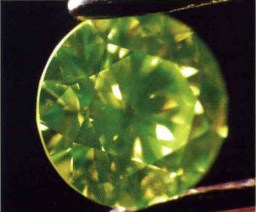
Figure 1: Deep-UV imaging of the CVD diamond showing the characteristic green fluorescence of high-temperature-treated CVD. Photo: SSEF.

This diamond was then observed under deep UV light (i.e., 225 nm) to observe its fluorescence reaction. The diamond exhibits a dominant green fluorescence colour with striations and planes fluorescing blue attributed to dislocations (Figure 1). The combination of green fluorescence colour and striations indicates a potential CVD synthetic. Surprisingly, after its exposure to deep UV, the diamond colour changed from colourless (greyish tint) to blueish-grey (Figure 2). This photochromic effect is not known for natural diamonds but is described in rare CVD synthetics.

Figure 2: Comparison of the colour of the CVD diamond under daylight conditions, before and after exposure to deep-UV light. Photo: SSEF.

To understand this photochromic effect, we recorded UV-vis-NIR spectra at liquid nitrogen temperature (ca. -196 °C) before and after UV exposure (Figure 3). Both spectra confirm that this diamond is a CVD synthetic, as testified by the strong absorption of the SiV- at 737 nm, a typical defect of CVD diamond (Figure 3). We also note that after UV exposure SiV- peak decreases by ca. 20% in intensity and that the absorption slope between 400 – 450 nm is flattened compared to the spectra without UV exposition, allowing more blue light to be transmitted and hence giving a blueish coloration to the CVD synthetic diamond (Figure 3).

Figure 3: Vis-NIR absorption spectra of the CVD diamond before and after exposure to deep-UV light. The spectra were collected at liquid nitrogen temperature (-196°C). Spectra: SSEF.

CVDs showing a similar photochromic effect were recently mentioned in the last update on lab-grown diamonds performed by the GIA (Magaña et al., 2024). The colour change is explained as a charge transfer increasing the intensity of the SiV0 (946 nm) at the expense of the SiV- at 737 nm. Those CVDs are thought to be intentionally doped in silicon to get a greyish-to-pink coloration.

This type of CVD synthetic is interesting for SSEF as it allows us to improve our understanding of the behaviour of defects present in synthetic diamonds.

References

Magaña, S. E., Hardman, M. F., Shoko, O., 2024. Laboratory-grown diamonds: an update on identification and products evaluated at GIA. Gems & Gemology, Vol. 60, No. 2, pp. 146–167, http://dx.doi.org/10.5741/ GEMS.60.2.146