The Hidden Gem Podcast – Episode #2 with Enzo Liverino: On precious coral, craftsmanship, and the heritage we pass on
Fourth-generation coral specialist Enzo Liverino joins Laurent Cartier to talk about precious coral — a material humans have prized for thousands of years, from Mediterranean fishermen to Tibet and the kings of Benin. From learning to read a coral branch as a boy in his father’s factory in Torre del Greco, to buying rough material in Japan and Taiwan in his twenties, Enzo shares a lifetime of knowledge — and makes the case that what really matters is the culture and heritage we pass on.

Podcast Transcription
Enzo Liverino: We have limited time, so the time that we have, we have to use to let what we have done remain. The information, the culture, and this kind of heritage that will remain for century and century in a place where the people can appreciate the coral.
Show Opener: SSEF presents the Hidden Gem Podcast, conversations with the world’s leading people behind the journey of gems and jewels, from the source to the finished piece.
Laurent Cartier: Today on Hidden Gems, I’m speaking with Enzo Liverino, a fourth generation coral specialist from Torre del Greco in Italy, the historic heart of the precious coral trade. We met at a busy trade fair, so you may hear a little background noise, but that setting feels fitting for a conversation about a material that travels the world. We talk about how coral is sourced and worked, why varieties like angel skin and ox blood are so prized, and how the craft. And the market have changed over the last 50 years. And beyond jewellery, Enzo shares why Coral is ultimately a story about culture, knowledge and what we leave behind.
Laurent: So Enzo, thank you so much for being here with me. We’ve known each other for more than 10 years. I’ve learned a lot from you about coral and you are such a knowledgeable person about coral. So I’d love to learn more about how you began with coral and your family. When did you start touching coral and working with coral? Can you share a little bit about that?
Enzo: Yes, the passion that I have for the coral was naturally started when I was six, seven years old because I lived with my father, with my mother, in the place where there was also the factory. So in the morning of course I went to the school and in the afternoon I had to make some study at home, when I finish around five, six o’clock, nothing to do, just play a little bit of football with my cousin, then I went to the factory. That time the factory closed at nine, nine thirty in the evening, and because I was the son of the owner, the worker, they were happy to teach me. So everybody come, and so come here, I teach you. You see, this branch of colour, you have to read where to cut, because the colour will tell you from here you can make a cabochon, from here, you can make beads, or from here you can make a work of art. And this was very useful for me when, at the age of 20, My father asked me – I wasn’t studying at the university- but my father said I’m sorry you you will study in China because we need the raw material. So I started to live in China, Taiwan and Japan because we needed a lot of raw material and of course in the beginning it was not easy for me. Because I felt the responsibility of buying at that time a million dollars of coral. But after I feel comfortable because what I have learned when I was a young boy came out. So I can easily understand from outside the dead coral pieces what can be inside. Even if the, I know that with the oxygen water, from a very dirty piece of coral, we can finally carve or make an angel skin figurine or angel skin necklace and so on.
Laurent: So corals have been one of the oldest gems collected by man.
Enzo: Yes.
Laurent: For several thousands of years in the Mediterranean. And they were traded around West Africa. They were traded all the way to Tibet, Marco Polo in the 13th century…
Enzo: I think so.
Laurent: …brought coral, precious coral, also to Tibet. What is the fascination, do you think, that humans have with coral?
Enzo: Well, if you design a map and in every place of the world you can put a picture with a lady wearing a traditional dress, there is always something with the coral. From Russia, Afghanistan, then Scandinavia, Holland, Poland. Russia is really say that we go little bit south Tibet, Nepal then even in Cambodia China China also the Emperor or the Queen they there are many image where they were the coral and then Japan Then on the other side of the world where we can find many Indian, Native American wearing coral. Inca also, there are some pictures in which they wear the coral. Then, in North Africa, they use a lot of coral in Morocco, Algeria, Tunisia. And then if we go on the south, Nigeria, where the coral was very important for ruling in Africa, because the King of Benin has a dress all made by coral. And the weight is 14 kilo. And since a century, the chief of a group, to become a chief, they must have many corals on their body. And when they died, they were put in the land with the coral.
Laurent: So that’s the thing is that coral is not just about the beauty and the colour, but there is some connection that people are symbols. So what is why do you think coral became so important or so attractive? What attracted you?
Enzo: Maybe the connection of the blood this can be one of the reasons because also in the mythology they talk they say that the coral come out from the head of Medusa going in the water becomes coral. Yes, then from this mythology it becomes more the idea of a coral connecting with the blood and with health, good health of course, and then also good luck. The symbol of good luck in Naples is the small horned cornetto.
Laurent: So you’re a healthy and lucky man. You have you have so much coral in stock and you have had so much coral, beautiful coral passed through your hands.
Enzo: Yes, what I would like to, that is now time to give back all the information that I get from this trade and also helping the trade of course, helping the scuba divers to not risk their life, so I am trying to change the European regulation with the sustainable use of robots like they make in Japan. So then educate the people on coral is my goal. And thanks to people like Laurent Cartier, Laurent, you was the first who start to help me in this mission. Maybe you forgot, but… I remember when I come to you and I said let’s make something to let people really understand the difference between the precious coral and the reef coral because there is so many misunderstandings.
Laurent: Yeah. Well, thank you very much. And we learned a lot from you as well.
Enzo: And we create also a website, sustainablecoral.org, that now the word sustainable is too much, you said, in the wrong way.
Laurent: But if we bring it back, I think what’s also very interesting is all the knowledge you have about craftsmanship, what you were explaining about these cutters who were in your father’s factory, who were showing you all this. Do you feel like, can you tell us a little bit about Torre del Greco, where you come from? Why is it that the coral trade is centred in Torre Del Greco? And how do you see the future of Torre de Greco. Are these skills being passed on?
Enzo: I think the coral will remain for many many years in the city of Torre del Greco. Torre del Greco people are very smart and we learn all the things that we know about coral. We learn from Genova and Livorno before the corals was worked there. Then we was lucky to have a French king and a French queen, Joachim Murat, his wife, Carolina Bonaparte. They loved the coral. They loved it a lot. And they made a special regulation, special law to help the coral people.
Laurent: To help the craftsmen or to help the fishermen or to help everyone trade?
Enzo: Everything, fishermen, factory, the teaching, they opened the first coral school in Torre del Greco. They opened the first factory. Before there was one [some] people that make the drill and other people who make the cutting. He got the idea. To call Marcia’s man and open a factory as an example for the other Torre De Greco people. Now, fortunately for us, the coral remains in Torre del Greco was brought in as a cutting also in China, but the most popular coral in the world right now is a Mediterranean coral and in Torre del Greco we know very well how to work.
Laurent: So this means that up until, what is it, 1800 or 1812, it was exclusively Mediterranean coral that had been traded and fished for thousands of years. And then beds of corals were discovered in Asia, right? And this radically changed the industry?
Enzo: Yes, at the end of the last century, the beginning of last century…
Laurent: …19th century, yeah….
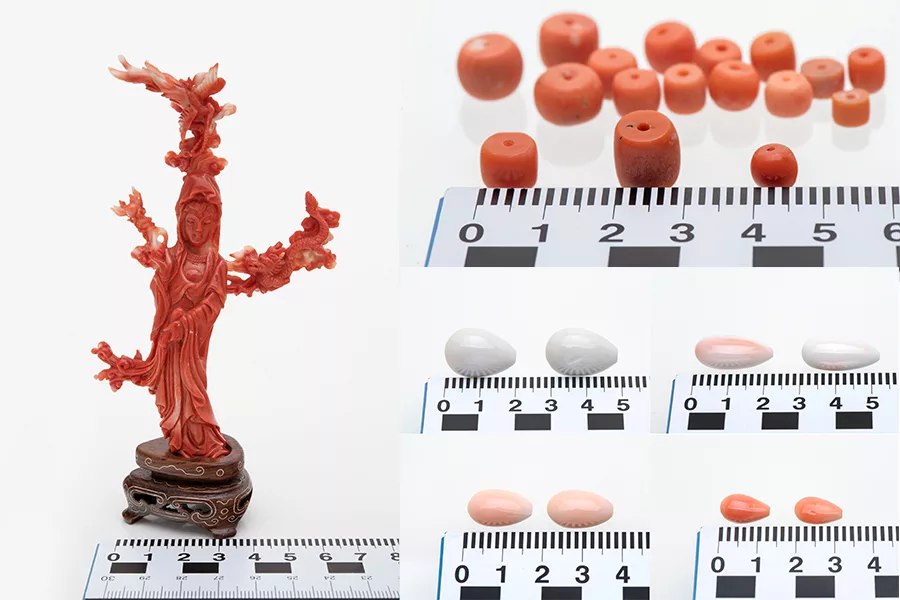
Enzo: …it was found in Japan and my grand-grandfather, he went there, it takes two, three months by boat, he went there and he found that there is this beautiful coral that at that time the German people they love. Because it was bigger than our coral, and there was the pink that also in, the French people, they like very much. And we are talking about the angel skin, of course, you know?
Laurent: Can you tell me the story about boké and the term boké?
Enzo: This is something that few people know, but my grandfather, of course, he was a dealer, he was business man. When he went to Japan to buy coral, Corallium elatius, we say cerasuolo, the colour of the cherries, and it’s medium red. And just… Very rare, you can find in one tonne, one piece albino, anomalous core, that is light pink. So he know that the value is much higher, but the Japanese, they don’t know. And when he start to buy, he make selection. All the light pieces he put on side. At the end, the Japanese was surprised. He said, Mr. Liverino, but what about this? At least this is no good. It’s not red, and it’s not white. It’s pink. It’s a stupid coral. And the stupid translating Japanese, they say the boké. So remain the word, boké.
Laurent: And Boké is one of the most valued varieties of precious coral today, right? Yes. Interesting. So how many generations has your family been in the coral trade?
Enzo: With my son, my two sons, Andrea and Basilio, they are the fifth generation, already prepare the sixth (laughs).
Laurent: Okay, and most people who are not very familiar with precious coral or coral think of coral as kind of, yeah, orange to red and that this is the colour, but there are many other varieties. I mean, we have thousands of coral species, but only a handful or two handfuls that are precious corals so that can be worked in jewellery. But can you tell us a little bit more about white varieties of coral, konojoi. Or the big discoveries of secundum that were in the 50s and 60s and all this material.
Enzo: Yeah, in that time I was in Taipei and the Taiwanese, they get news that there was coral in Midway Island.
Laurent: Which year was this?
Enzo: About 1970, 1970. And then they started very big boat. They went together with the Taiwanese and Japanese boat. They went there, and they start to fish. And they come back with each boat 300 tonnes of coral, each boat. Amazing.
Laurent: And this was very deep, right?
Enzo: Three, four hundred, five hundred metres, then after a few years they found also a location where they found coral at two thousand metres, two thousand metre deep. So this is interesting to understand that the coral, precious coral, is very strong. And now we are studying together with the scientific centre and the university. Why the precious coral is so strong, so powerful. Understanding this, we can help the coral reef. We can better understand because the precious corals so deep, cold water, no light, very strong wind, but still there and grow up very fast. All the studies that they have made on Mediterranean coral and other corals are helping the reef coral to not have too many problems or damage. Also on this I would like to say just a couple of words that we don’t have to worry too much about the death of reef coral. Because it’s something that is made by our God, or Buddha, or which we believe. Because it is natural that somebody died and then create other situation. The coral reef, he born and lives very fast. So it’s natural that part of it died. And when we go in the nice beach, we have a fantastic sand, white sand, where we can enjoy with the family.
Laurent: But we still need the corals for the fish, for the whole ecosystem. So are you, I mean, I think there’s a lot of scientific evidence showing that with warmer waters and more acidity, more CO2 in the water, it’s getting more difficult for coral to form. Are you worried that in a hundred years time or two hundred years there won’t be anymore precious coral?
Enzo: No, I don’t know. I believe in God, so I know that he will control everything, he will make everything good.
Laurent: And you said you were spending time in China in your 20s, how was that experience? Do you speak Chinese?
Enzo: No, unfortunately, no.
Laurent: A suitcase full of cash and you bought rough material or how did it work?
Enzo: No, we went there and we have a credit because they don’t know me, but I have since my grandfather and grand grandfather connection with the Japanese and the Japanese in that time they was accredited very well in Taiwan and in China. So I went there together with those Japanese that becomes my agent and when I buy they can I would say, give a credit on me and say, no problem, if Mr. Liverino don’t pay, we will pay you. And this helped me a lot.
Laurent: And which part of China was this? Hainan Peninsula, or?
Enzo: No, Hainan, the Japanese are very smart because the Japanese, they went in Vietnam and they were not allowed. They fish the coral. When they come back in Japan, they say that was fished in Hainan. Just don’t let the Taiwanese people know that that colour lives in Vietnam because konojoi was very precious. The price was very high. Still very high!
Laurent: This is white precious coral.
Enzo: Yes, because not so many and very useful for jewellery, precious jewellery, because it’s uniform. The other coral that comes from Midway is pinkish And for a high jewellery brand, it doesn’t work.
Laurent: They want something more homogenous?
Enzo: Yes, right, yes.
Laurent: I remember I visited Taiwan in 2016, you gave me some contacts and in the southeast I visited a jewellery shop of chili coral back then and it was over 7,000 square metres of coral jewellery. I said back then to them, I said, probably you’re the biggest jewellery store in the world, you should be in the Guinness Book of World Records. Absolutely incredible. This made me understand that a lot of the market for precious coral is also found in Asia. How has this changed over the last decades or centuries? Is the market really in China?
Enzo: The market still remain in China and the fortune of Chii Lih coral was that in that time the policy between the government of Taiwan and China was more friendly, more open. So Taiwan can get many visitors coming from China that went to Taiwan to buy coral. That’s the reason why Ming Li Chii Lih coral open a shop that the first was 700 square metre and she made another four shops and the last shop was a 2000 square metre so when i went there i can see outside waiting the tourists 200 bus 250 bus and then as always something happened the government the taiwanese government Chinese go and they start to disagree on many things. China doesn’t give more visa to the Chinese to go to Taiwan.
Laurent: But what really impressed me was the fascination. So one thing is that this was tourism or shopping, but it means the Chinese people really have and had this deep cultural link.
Enzo: Yes, with coral.
Laurent: And when I visited Taipei 101 there was a necklace I think that was retailing for over a million US dollars, you know, Oxblood. I mean, incredible value.
Enzo: Yes, and at that time there was also an amazing necklace of Angel’s skin. We were, and we are, very close with the owner, Ming Li, and during a congress that she organised, she bring all the guests one-on-one, and maybe there was not the Oxblood necklace where they was. A very big angel skin necklace. And she said, this is the biggest angel skin necklace existing in the world, 650 gramme. And then joking with the people, she said there is only one man that can appreciate this necklace and this is Enzo. And then I, just joking, said, thank you very much, Ming Li but, uh… Please, sell to me. So she was a little bit embarrassed. And looking at the people around, she opened the window. She take the necklace, and she gave it to me.” She said, OK, it’s yours. And I bought it.
Laurent: And you still have it today.
Enzo: Of course.
Laurent: So this is your personal collection and you have a museum in Torre del Greco, right?
Enzo: And regarding the museum, I’m very proud of it because… There are some other museums, but specific, on the Chinese art, or Japanese art. What the experts say that, when you come in my museum, it’s completely new, starting from last century, siacca coral, used in Trapani to make artwork. Then Neapolitan jewellery, and then in old China and new Chinese pieces, Japan, modern art. And then the last section of the museum was opened a couple of years ago. To give the right space to the contemporary art. Because seven years ago, I started to work in collaboration with, I think it’s the number one contemporary artist in the world, Jan Fabre. In that time, he made a piece of art using different material. Just for luck, he visited my museum and he was shocked and he said no Enzo. I already have some idea with concrete idea. We will do something really fantastic and we have done we made some pieces that was sold to a very rich collector, some museum and then together we decided also to donate something to Naples. And we donate four big pieces of art in Pio Monte della Misericordia. And another donation was a big frame of coral, two metre by two metre, with the symbol of San Gennaro. And this was a donation to the San Gennaro treasure.
Laurent: Is this you giving back or is it you expressing the fact that coral is let’s say a work of art from nature and this is like an extension of that that, the work of Art of Nature deserves to collaborate with you know the human spirit or the human mind in creating more art or what is your your vision behind collaborating with artists and not just keeping coral for jewellery as beads or cabochons.
Enzo: But we have a limited time, so the time that we have, we have to use to let what we have done remain. And what we can leave is the information, the culture, and this kind of heritage that will remain for centuries and centuries. In a place where the people can appreciate the coral and what is the coral.
Laurent: And of all coral types and coral varieties, do you have a personal favourite?
Enzo: Let me say that the Mediterranean…
Laurent: or is that a trick question?
Enzo: No, I like Mediterranean because I’m very familiar, especially in the last 10 years it’s become more easy to work with the Mediterranean as a trader. If I have to say that my favourite coral is Mediterranean, it’s not because I like the light colour, so angel skin is my favourite.
Laurent: And you mentioned before Sciacca coral. Not everybody is familiar with that, but can you tell us a little bit about Sciacca and your relationship to Sciacca?
Enzo: Sciacca coral still belongs to Corallium rubrum, that is Mediterranean coral, and was a deposit of coral found, the history says that it was found in 1875, in my opinion was found much before that time, because… I know that Islam was very close to the coral for religion and also for the fishing. They invented the tools to fish the coral in the 10th century.
Laurent: In North Africa, right?
Enzo: In North Africa. And they used tools in a way that they don’t lose the nets. And there was also a selective way to fish the coral, because they used broken nets. The broken nets, they take only the big branch, leaving the small one. So it was a selective and, of course, sustainable way. What happened in Sciacca? That the strong current coming from Sardinia, Tunisia, Algeria, and so on, the broken piece of small Sardinian coral was bringing it through Sicily. And in the Sicily channel, the current changed, stopped. So the coral that arrived there went down. On the sea base and remain there, century after century, and create a deposit high 30 metres. So you can imagine in thousands and thousands of years that there was this phenomenon. 30 metres, there are also many, many colours, because on the top was of course red. The more you go down. The coral when it dies becomes orange and become pink. There are some also line that was smoked by the volcano close to that area. The volcano that created the island, Ferdinandea Island, a volcano that is in Sicily, yes, a volcano that born in one year and after one year was destroyed by himself, but the lava hit that line and the coral on that line was smoked, black outside but still orange inside. And then the coral, there are so many things to say about the Sciacca coral. Since 20 years, I am writing notes. Finally, I met my best friend, Henry Ho, who lives in Bangkok. And he said, but finish your book! I will edit it for you. And now it’s ready. In the next week, I will send to Henry. And we will print the book.
Laurent: We look forward to reading the book. So why do you think that it was discovered before 1875? They had the tools, but you think they brought it to market?
Enzo: No, no, because my father in 1960 he bought the biggest and oldest coral factory in Italy, company name was Costa, that closed in 1930 because of the war in Russia. No family remain so they donate everything to a small church near Genoa. The church, they have all this coral but they don’t send nothing so they contact my father and my father pay a lot, but the priests say, Mr. Liverino, you buy the coral, of course. But you should also clean the house, the room, because I have to, as a church, I have to sell it because I need the money to repair the church. So my father was very happy to bring in Naples all the documentation that they have. During the pandemic, I studied all these documents together with my staff. And we found some document in which Sciacca, eh Costa company some piece of paper write by hand in which they bought coral from Arabic people before Sciacca coral before 1875. And there are some also invoices made in the United States or in Russia or in other parts of the world for a big amount. Of necklace of Sciacca coral. And the date of the invoice was before the 1875.
Laurent: And so how much of the Sciacca coral deposit is there left? I mean, that’s what’s so interesting. It’s like if it’s a coral mine or a coral deposit, right?
Enzo: It was a deposit, it was not a mine, is finished now. It’s finished.
Laurent: Wow, that’s interesting. And so what do you think are the best light conditions to see coral, to touch coral? If somebody has never worked with coral before or worn coral, what would you recommend?
Enzo: Now with the new technology the light doesn’t make any damage to the colour because the colour doesn’t love the hot temperature so mostly now the light are with the LED and this personal test if you like warm light or cold light depend on also sometimes the pieces from the carving and from the feeling that you want to give to the if it’s an artist piece.
Laurent: For many centuries, Carl, there was big debate, is it animal or is it a plant? Any thoughts on that? Also, when you get the branches afterwards, obviously you never just use the rough material, you have to cut the rough material, you have shape it, and then you have polish it.
Enzo: No, there is, as you know very well, when you fish the coral, outside there is a skin in which the polyps live. After one year, that polyps die and they create the basis for another generation of polyps. And the soft part, when we fish the corals, in a couple of hours, will become dry. And If we keep in the deposit for a year, of course, because we never used to fish the coral and cut. We like to keep for a long time, and also because each area has different colour. So North Africa, the colour is more light, and French coast is more darker.
Laurent: Why do you think that is?
Enzo: There may be some small differences in the polyps, but it’s a good question. Maybe we can ask the scientific centre in Monte Carlo to give an explanation. And also in Corallium rubrum there are the boké/bokeh. And they, in Monte Carlo, they have in cultivation for study. A branch of a coral. Very funny, also to understand what’s happened in that albino piece of coral.
Laurent: Yeah, I saw one of those I visited in December in Monte Carlo, very interesting to see how they’re growing.
Enzo: Fantastic people.
Laurent: What is so difficult and what is so rare about precious corals is that we can’t just cultivate corals.
Enzo: We can cultivate for study.
Laurent: But not for commercial?
Enzo: But not commercially. But it doesn’t need also because there is a lot of coral.
Laurent: You still have a lot of old stocks?
Enzo: I still have a lot of old stock and of course I have to think on the future. So we cannot expect only the coral fished by the scuba diver because it’s too risky for them. We must work to change the law because it is a stupid law.
Laurent: So right now the law is that you have to dive, but it has to be below how many metres? 50? 100?
Enzo: No, now they are changing again, they make more stronger.
Laurent: For the Mediterranean?
Enzo: Because it was 50, now it’s 80.
Laurent: It’s tough diving under 80.
Enzo: And then you can reach 100 metres, 100 metres 120 metres, but no more. And you can be there for two, three, five minutes. And very risky. When we can make a very strong regulation on the fishing with the robot. And the robot, it’s not me that say, I say that. The robot is. Really sustainable because the robot has two hands, of course the robot has a monitor video and if he found a small branch he doesn’t care, he go more far to find a big branch. When he finds it with one arm he takes the big branch and with the other arm he just breaks the small branch that goes in the rock and creates other coral colonies.
Laurent: Yeah, colonies, yeah. Interesting. And this is how they do it also in Japan, right? They have a lot more experience.
Enzo: In Japan, the law is that the car can be fished only by ROV. Only by ROV. And in Europe, we have just the opposite. It’s stupid.
Laurent: Well, let’s see where that goes. But there are still a lot of old stocks left, like in Torre del Greco, people have. Yeah, so you are not worried for your, I guess, your son still has coral to work with. And you said that the next generation is already being prepared.
Enzo: We have to think about the next generation. Of course, I cannot think that if they start to fish coral with the robot, the robot will fish a lot of coral. No, it’s not true because they can fish only six months per year. There are some, another three months of the six in which the weather is no good, and it takes time, takes a lot of time. They should have a licence, they should have big boat. It’s not something easy like they imagine. You just take a small boat with the rope and then you go to take a coral. It’s not like this.
Laurent: And where’s the demand for precious coral today, in terms of markets and continents? How has that evolved over the last 50 years?
Enzo: Well, as always, there are ups and downs on the market and there are some countries that start to use more and then after a couple of years they remain stable and grow up in other markets. So we went from Saudi Arabia market up to Russia, then come back to Germany, United States. Until a couple of years ago the United States was the first market for us. Let’s say that now the country with the French influence they are the one that give us a work and mostly of the bigger brand the famous brand they are French.
Laurent: And they also used a lot of coral during Art Deco, during the 50s, 60s, 70s also. There’s a lot the big brands worked so much with coral that they’re revisiting some of the…
Enzo: Really right, right, yes.
Laurent: We have this cultural heritage of having corals, right? And the… Same for Italian brands.
Enzo: There are not so many creative designers or creative people. There are some, but not so much like before. So they are studying the old collections to try to get some idea from what they have made before.
Laurent: And do you cut the coral yourself, or do you polish yourself?
Enzo: Yes, I like, I like to do it.
Laurent: And you also like to paint, right?
Enzo: I like to paint.
Laurent: What do you paint?
Enzo: In the beginning, I started to paint when I was really very young, classic things, a vessel or a house and so on. Then, I start to be more interested in, let’s say, contemporary art. And I understand that I won’t use coral. In the beginning, I used coral powder. The one that remains when you finish to work, to cut, it remains like a powder.
Laurent: But as a paint pigment, or you use the powder as colour? No, I use it.
Enzo: I glue on the painting, on some part of the painting. But then I use the same technique used by Jan Fabre. So some, let’s say, paintings of mine, they are in 3D. And there is a face. And the part of face is covered by a branch, coral, a small cabochon. And so on. Also using a different colour. So mostly the Sciacca colour helped me a lot because the Sciacca has maybe 40, 50 different nuances of colour.
Laurent: That’s incredible diversity that you can do with it. And then with your grandchildren, because you said you’re preparing the next generation, what are you teaching them about, coral? How are you getting them interested?
Enzo: Well, some of course are more interested than others, but mostly they want to imitate me, they want to make something that I do. So when they come to me, they see that I make paintings, they want to paint together. So I prepare four tablet, oh five, because I am one of them. And they say, what do we want to do, a house or this or that? And we will do together five different things. The oldest one, of course, now they are more interested in making some concrete things and something that is more close to my heart, let’s say art. And then I want to also say that we are cooperating now with an organisation in Naples who has 15 young people who limited our, I don’t know if it’s in English, autistic. Autistic or syndrome down.
Laurent: Yes, Down syndrome.
Enzo: And for one year, we teach them everything about coral. So we start in January, three months, the theory, with using Keynotes, the image. The coral is this. Then it was fished like this. Using the technique of Rui [Galopim de Carvalho], for instance, okay, let’s go down to see the coral in the water and the image is completely black. Why? There is no image. Because we forgot to switch on the light… Switch the light and you can see the coral in the sea and they feel enthusiastic. So moving them, now they have a passion and especially when they understand that I want to teach them how to do some object using a poor quality of coral, but they have made one, we start with the frame, small frame, and the side of the frame they glue a piece of coral. Someone make better, someone make less. But really, yeah, it’s really inspiring. My technique, I am teaching to them also even what to put inside because inside you can of course you put a picture but you can even put your design, your sketch that you will cover with shell, with some small pieces broken of turquoise or with other material just to create.
Enzo: You know, my brother-in-law has Down syndrome and he loves to paint, so maybe I come to Torre del Greco and you teach us both together.
Enzo: Yes, my sister has down’s syndrome, maybe for this reason I like to teach that. And one thing is that I don’t like to communicate these things because I made it because I like it to do. I don’t want to let people know that I do this because I do it because I like to do.
Enzo: Yeah, you do it from the heart.
Enzo: Right. And at the end of the year, we will make an exhibition. They will sell what they have made. And the money will go there.
Laurent: So when will this be?
Enzo: At the end of the year.
Laurent: at the end of this year 2025.
Enzo: And then we will give to them a diploma. They will become a Coral Ambassador. With the mayor of the city of Torre del Greco. Italian flag, make a nice ceremony.
Laurent: That’s really inspiring. That’s a great way of giving back. And maybe some of the pieces will then also end up in your museum, right?
Enzo: Why not?
Laurent: Well, I look forward. Thank you very much, Enzo, for this conversation. Thank you, Laurent. I realise that I need to come back to Torre del Greco. Of course. To see the museum and come and visit you again and visit the workshops and learn more. So thank you very for your time and sharing all your expertise and your wisdom.
Laurent: Thank you. Thank you very much, Laurent.
Laurent: Our guest Enzo Liverino reminding us that what we leave behind is knowledge and culture. That was another Hidden Gem by SSEF, the Swiss Gemological Institute. Thank you for listening.