Study on sapphires with “exotic” elements and implications for heat treatment detection

By Dr. Michael S. Krzemnicki, first published in Facette 30 (March 2026)
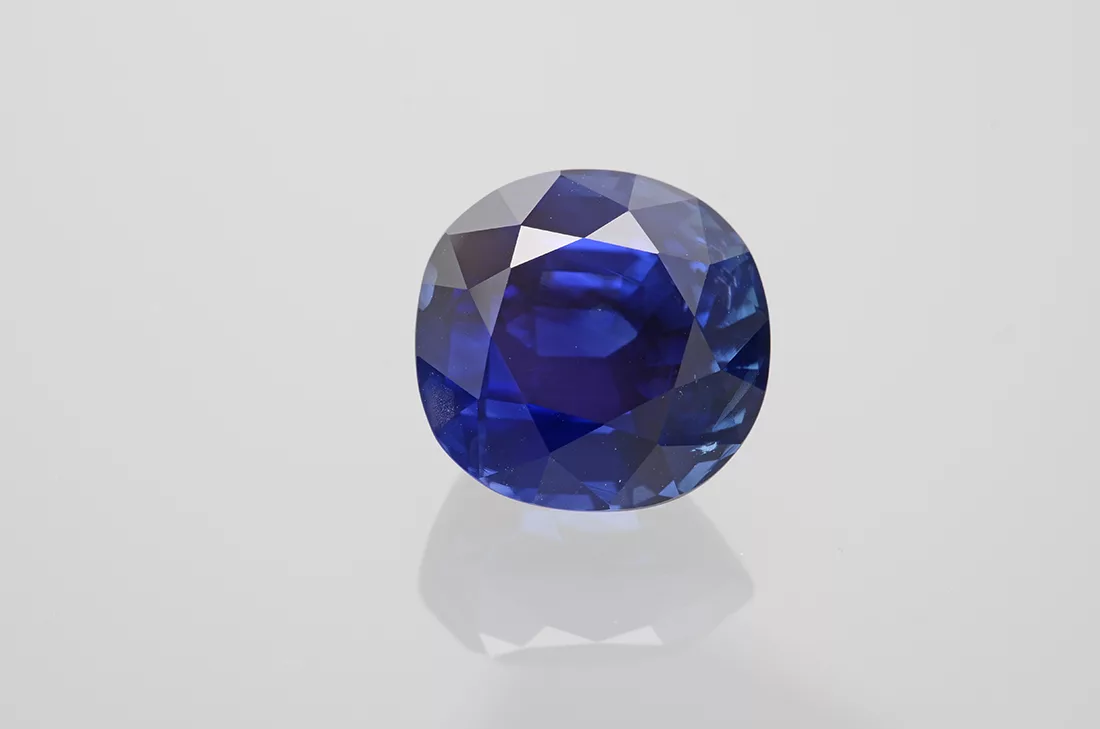
In a recent study, we analysed a series of unheated gem-quality sapphires containing ‘exotic’ elements such as Sn, Nb, Zr, Ta, W, also known as high-field-strength elements. These sapphires often exhibit a beautiful velvety blue colour due to very finely dispersed nano-inclusions in ‘milky’ clouds and zones. From a gemmological point of view, these sapphires are even more interesting as any beryllium they contain is natural, not the result of diffusion treatment. In addition, some of these sapphires may also contain traces of thorium, which enable us at SSEF to determine their geological age using radiometric dating methods.
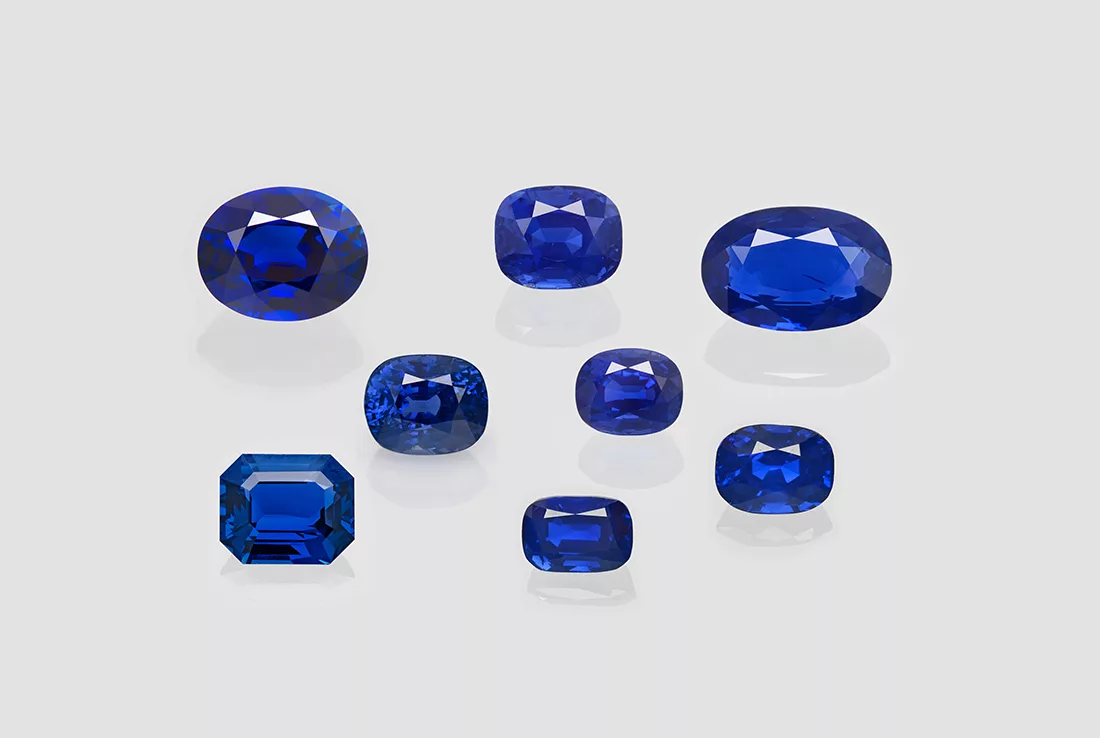
Figure 1: Selection of unheated sapphires (5.7 ct to 50 ct) from Madagascar and Sri Lanka used for this research study. Photo: SSEF.
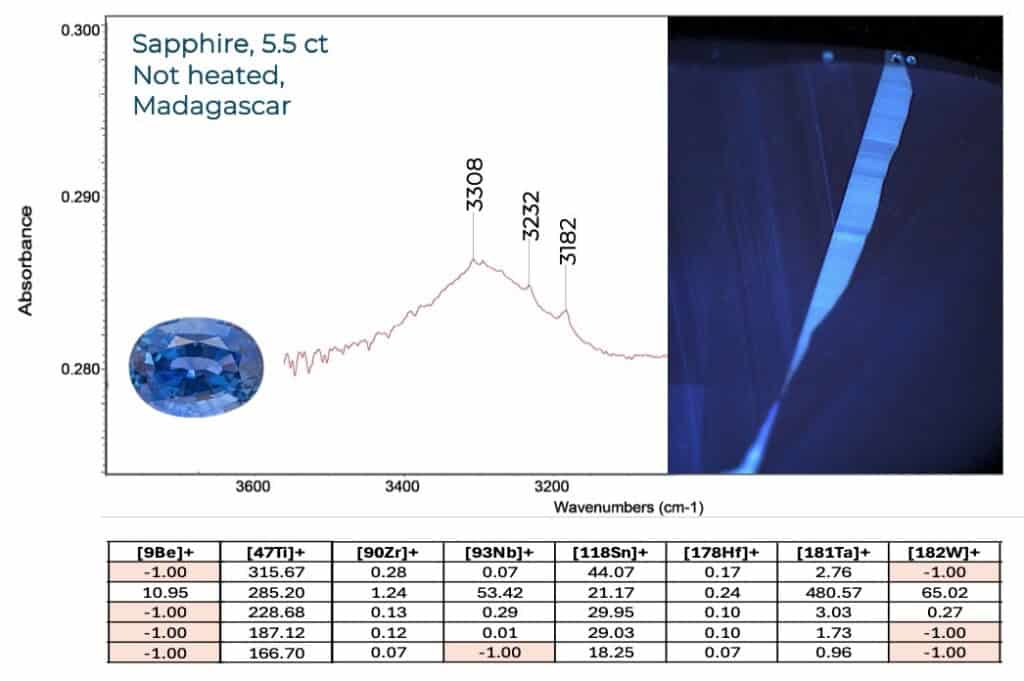
Raman micro spectroscopic analyses revealed the presence either of goethite, diaspore, or strongly metamict zircon inclusions, or a combination of these inclusions in all investigated sapphires with ‘exotic’ elements. This is clear evidence that they were not heat treated. Interestingly, these unheated sapphires with ‘exotic’ elements often show complex FTIR spectra, dominated by a broad absorption band at about 3300 cm⁻¹ and occasionally small peaks at 3309, 3232, and 3185 cm⁻¹ (so-called 3309 series). Namely the peak at 3232 cm⁻¹ has been considered so far a key criterion to detect heat treatment in corundum. Our study reveals that such peaks can also be found in unheated sapphires.
Figure 2: FTIR spectrum of an unheated sapphire from Madagascar containing traces of ‘exotic’ elements, especially enriched in the zone showing strong bluish white chalky SWUV reaction -1(.0p0hotoontheright). Thespectrumofthisunheatedsapphireexhibitsabroadbandat3300cm-1 and small peaks at 3308, 3232 and 3182 cm-1. Figure: M.S. Krzemnicki, SSEF.

In addition, we found that sapphires with ‘exotic’ elements often show zones with a distinct chalky bluish white reaction under shortwave ultraviolet light. Again, commonly regarded as an indication of heat treatment, our study on these unheated sapphires proves that chalky reactions can also be observed in unheated sapphires.

This study was first presented at the International Gemmological Conference 2025 in Athens (Krzemnicki et al. 2025). It underlines that a simplistic approach for no-heat/heated distinction can be erroneous specifically for metamorphic sapphires with velvety colour appearance (slight ‘milkiness’). Only a full characterisation of these sapphires including Raman spectroscopy on inclusions (diaspore, goethite, zircon) and detailed trace element analyses (LAICPMS) may provide the answer whether such a sapphire has been heated or not.

References

Krzemnicki M.S. et al., 2025, HFSE-enriched sapphires of gem quality:
A combined FTIR and trace element study and implications for heat treatment detection.
Proceedings of the 38th International Gemmological Conference, October 2025, Athens, Greece. Pages 122-124.