New discoveries in precious coral research

By Dr. Laurent E. Cartier, first published in Facette 30 (March 2026)

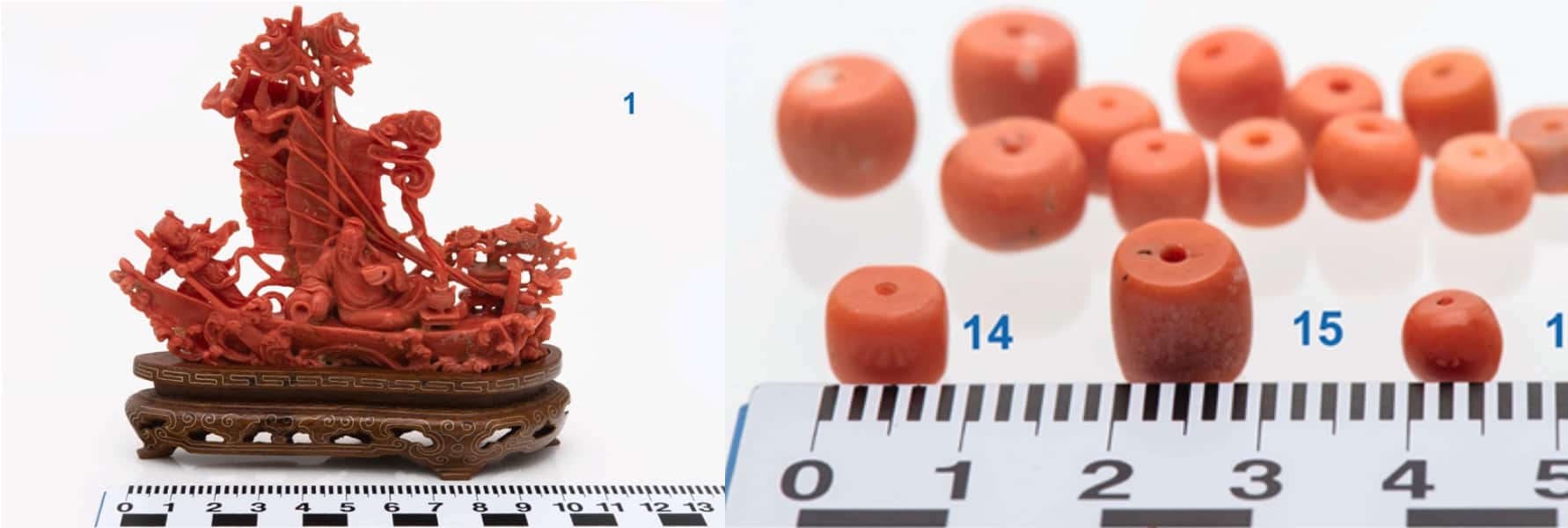
Precious corals are not just used in jewellery, but also in complex objects and statues such as seen here in a temple in Taiwan. Photo: L. E. Cartier, SSEF.

Since first publishing our DNA fingerprinting approach on precious corals in 2020, we have made considerable advances and discoveries in this space. This work is the fruit of collaboration with with scientists from the University of Zürich and other research institutions worldwide. 2025 was a particularly fruitful year as we published 3 publications in peer-reviewed journals on the discovery of a new species, providing new knowledge on Pleucorallium secundum and sharing insights on how DNA testing can be integrated into gemmological testing.

Introduction

Corals are formed by compact colonies of many individual polyps. These polyps secrete calcium carbonate to create a hard skeletal structure that offers them shelter and structure. The material utilized in jewellery is, in fact, the hard coral skeleton itself. Similarly to pearls, precious coral is thus a product of biomineralization. Unlike reef corals that live in shallow depths, precious corals are found in much greater depths (generally 50- 1500m) in the Mediterranean, Asia and the Pacific. Protecting precious coral species involves two primary levels of regulation. The first involves regulating fishing practices within the source regions, including the Mediterranean, Japan, Taiwan and China. The second level is regulation at the trading stage through the Convention on International Trade in Endangered Species of Wild Fauna and Flora (CITES), which entered into force in 1975 to address concerns that international trade was endangering numerous species. China requested in 2008 that certain precious coral species be listed (Table 1). The deep-sea environment of most precious corals dictates an extremely slow rate of growth for these species. Due to this exceptionally slow growth, it is challenging to cultivate precious corals in a way that is commercially feasible.

Because only certain species are listed by CITES, it is imperative that species are identified correctly. This has traditionally been done on a visual basis by dealers and customs agents, but visual identification has its limitations. Because many precious coral species share very similar characteristics and colours, traditional gemmological techniques often fail to tell them apart. However, by reading their genetic fingerprints, it is possible to identify different species unambiguously. This allows for greater transparency and enables the further documentation of the provenance of both historic and modern precious coral jewels.

A polished Corallium rubrum branch. Photo: SSEF.

Species and the spectrum of trade

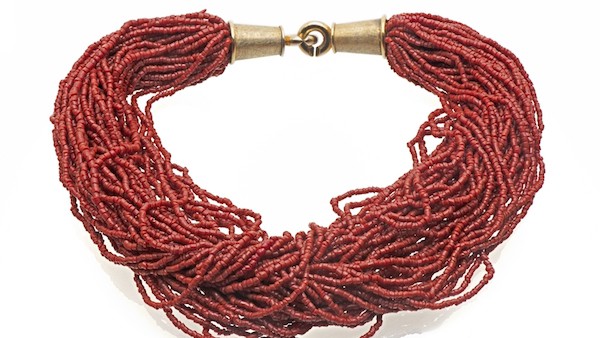
Precious coral manufacturing and sorting in southern Taiwan. Photo: L. E. Cartier, SSEF.
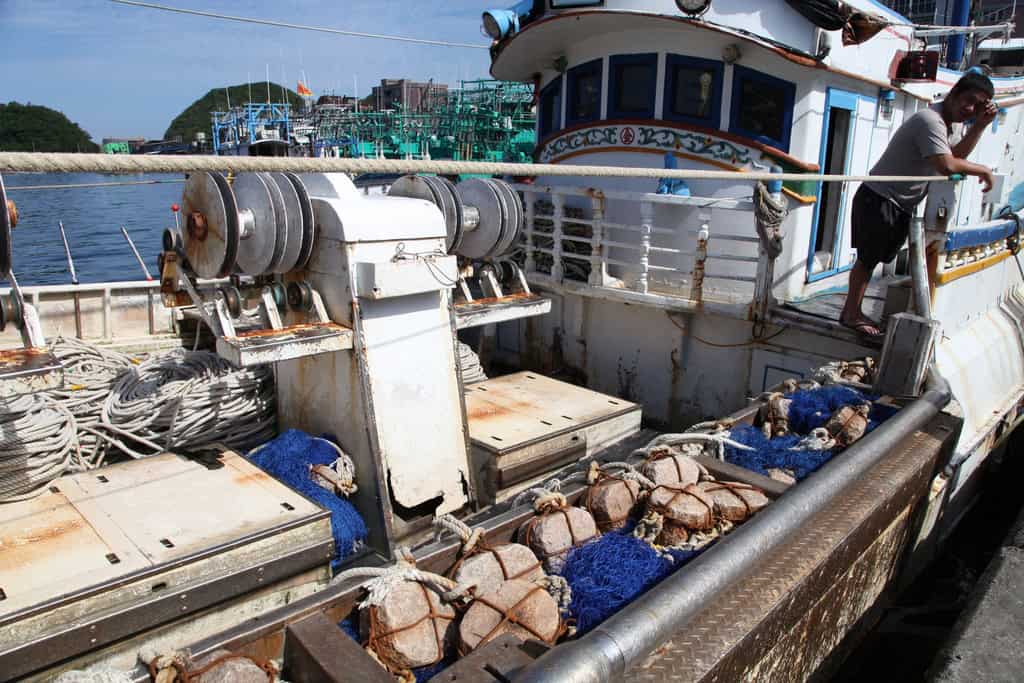
A coral fishing boat in the port of Su’ao in Taiwan. Photo: Laurent Cartier.

Of the thousands of coral species existing in the ocean, only a very small number can and have been used in jewellery. These are the ones called precious corals and varieties include red, pink, orange, and white types, all belonging to the family Coralliidae.

The main species found in the jewellery trade, alongside their distribution and traditional market names, demonstrate the complex taxonomy of these gems:

Table 1: Simplified precious coral description table (based on CIBJO, 2024).

DNA testing: A new era of identification

A significant step forward in coral species identification occurred in May 2020 with the publication of a study in the journal Scientific Reports. The paper, entitled “DNA fingerprinting: an effective tool for taxonomic identification of precious corals in jewellery,” detailed a methodology to conclusively identify a precious coral species.

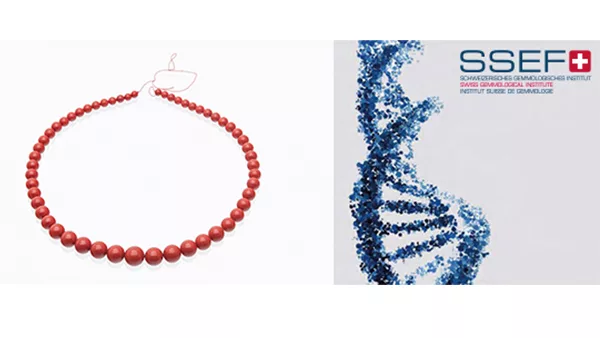
An angel’s skin precious coral necklace that was found to be from a member of the Pleurocorallium norfolkicum species complex. Photo: SSEF.

A significant step forward in coral species identification occurred in May 2020 with the publication of a study in the journal Scientific Reports. The paper, entitled “DNA fingerprinting: an effective tool for taxonomic identification of precious corals in jewellery,” detailed a methodology to conclusively identify a precious coral species.

This 2020 research marked the first major scientific study to describe a technique capable of using minute amounts of DNA recovered from precious coral used in jewellery to accurately identify the species. Crucially, the technique is considered quasi non-destructive and requires significantly less sample material than other analytical methods, with testable DNA successfully recovered from as little as 2.3 milligrams (0.0115 carats) of material.

One of the main findings was the discovery of a new species, Pleurocorallium niveum (originating in the Pacific), which had never previously been reported in the jewellery industry but was identified in several submitted coral cabochons. This finding underscored that there is still much to learn scientifically about precious corals.
In 2022, another study (published in Forensic Science International: Genetics) presented the Coral-ID method that was tested on a real-world set of samples, comprised of 20 coral-set items seized between 2009 and 2017 by the Swiss customs authorities, because they lacked valid CITES documentation. Three of the 20 tested samples were shown to be from species that have not previously been associated with precious coral in the jewellery trade. This further underscored the need for additional scientific research.

This led to the latest research published in 2025 in two peer-reviewed journals —one in Coral Reefs and one in Diversity. The Coral Reefs study addressed existing taxonomic uncertainties, specifically regarding the CITES-listed species Pleurocorallium secundum. We revisited the 1840s holotype (a holotype is the official ‘reference specimen’ for a species) of this species, which is housed at the Smithsonian National Museum of Natural History in Washington D.C.. By employing low-copy DNA analysis, the study provided genetic transparency and confirmed that the original and subsequently identified specimens are indeed the same species.

The second paper, published in Diversity, focused on a rare ‘angel’s skin’ (see image page 19) necklace that was submitted to the SSEF lab. Angel’s skin precious coral material is highly valued for its delicate light-pink hue and can command top-market prices. DNA fingerprinting conclusively demonstrated that the material did not match either of the two species that might have been visually assumed to match with this type of material (Pleurocorallium elatius or Pleurocorallium secundum). Instead, the material matched a newly identified precious coral species hitherto unknown both in the precious coral trade and to gemmologists. It was identified as belonging to the Pleurocorallium norfolkicum species complex. The material matched colony fragments that have been traced to Vietnam.

Implications for the trade

The discovery has some practical implications for the precious coral trade, particularly concerning regulation. The described ‘angel’s skin’ coral necklace analysed had initially been considered as being CITES listed because it was presumed to be Pleurocorallium elatius. However, since the material was identified as the Pleurocorallium norfolkicum species complex, and a species never before considered by CITES, the CITES listing is no longer relevant for that specific material. What began as a forensic challenge in species identification has now become a valuable doorway to discovering new species within the precious coral trade.

In the 13th century, Marco Polo famously spoke of coral in Tibet saying “coral is in great demand in this country and fetches a high price, for they delight to hang it round the necks of their women and of their idols.” As demand for high-quality precious coral material continues to increase, the regulation of the trade (e.g., through CITES) will remain important, as will ongoing efforts for marine conservation in producing regions such as the Mediterranean, Japan, Taiwan, and China. Education for consumers, alongside continued research into coral species, colours, treatments, and sources, is equally vital. The cultural and historic importance of precious corals through the ages is evident, and through these continuous scientific advancements, the ability to trace and document these magnificent treasures of nature provides greater transparency for the coral trade and ensures their important place in the world of jewellery.

Acknowledgements

We highly recommend Basilio Liverino’s book “Red Coral-Jewels of the Sea” to readers interested in learning more about the diverse history and world of precious corals. This is a shortened version of an article published in InColor’s 2026 Winter issue.

References

CIBJO, 2024. Coral Blue Book, 39 pp. https://cibjo.org/wp-content/ uploads/2024/11/November-2024-Coral-Blue-Book.pdf
Galopim de Carvalho, R., 2018., Precious corals, InColor, Vol. 38, pp. 70-78.
Lendvay, B., Cartier, L.E., Gysi, M., Meyer, J.B., Krzemnicki, M.S., Kratzer, A. and Morf, N.V., 2020. DNA fingerprinting: an effective tool for taxonomic identification of precious corals in jewelry. Scientific Reports, 10(1), p.8287.
Lendvay, B., Cartier, L.E., Costantini, F., Iwasaki, N., Everett, M.V., Krzemnicki, M.S., Kratzer, A. and Morf, N.V., 2022. Coral-ID: A forensically validated genetic test to identify precious coral material and its application to objects seized from illegal traffic. Forensic Science International: Genetics, 58, p.102663.
Lendvay, B., Morf, N.V., Cartier, L.E., Krzemnicki, M.S. and Nonaka,
M., 2025. Trace DNA from a century-old holotype specimen resolves taxonomic uncertainties: the case of the Hawaiian pink precious coral (Pleurocorallium secundum), a CITES-listed species used in jewelry. Coral Reefs, 44, pp. 1211–1225.
Lendvay, B., Cartier, L.E., Sato, A., Krzemnicki, M.S., Nonaka, M., Yasuda, N., Takata, K., Hayashibara, T., Morf, N.V., Iwasaki, N., 2025. Genetic testing of a high-end ‘Angel skin’ precious coral necklace identifies a species new to the precious coral trade and potentially new to science. Diversity, 17(6), p.395.
Lendvay, B., Cartier, L.E., Sato, A., Krzemnicki, M.S., Morf, N.V., 2025. Species identification of coral jewellery by genetic testing: case studies, experiences and prospects. Journal of Gemmology, 39(7), pp.688-696. Liverino, B., 1989. Red coral. Jewel of the Sea. Bologna.