Väyrynenite of exceptional quality and size, reportedly from Nigeria

By Dr. Michael S. Krzemnicki & Dr. Laurent E. Cartier, first published in Facette 30 (March 2026)

Figure 1: Fine-quality väyrynenite, reportedly from a new find in central Nigeria, recently entered the gem trade, as shown by these 16 ct (left) and 12 ct (right) faceted stones. Also seen here is a prismatic crystal weighing 2.2 g. Composite photo: SSEF.

Väyrynenite, ideally Mn2+Be(PO4)(OH,F), is a rare phosphate mineral that was first discovered in 1935 in a granitic pegmatite near Orivesi in southern Finland. Gem-quality väyrynenite has been described only from northern Pakistan (Shigar and Gilgit areas; Bank & Schmetzer 1979; Laurs & Fritz 2006b; Zwaan 2016) and from Afghanistan (Laurs & Fritz 2006a), but generally in small sizes (usually <1 ct) and often quite included. However, these stones are highly appreciated by gem collectors due to their attractive padparadscha-like orangey pink colour and their rarity. Until recently it has been known in gem quality mostly as small, often included stones from northern Pakistan (and less commonly, Afghanistan). Nigeria is the newest producer.

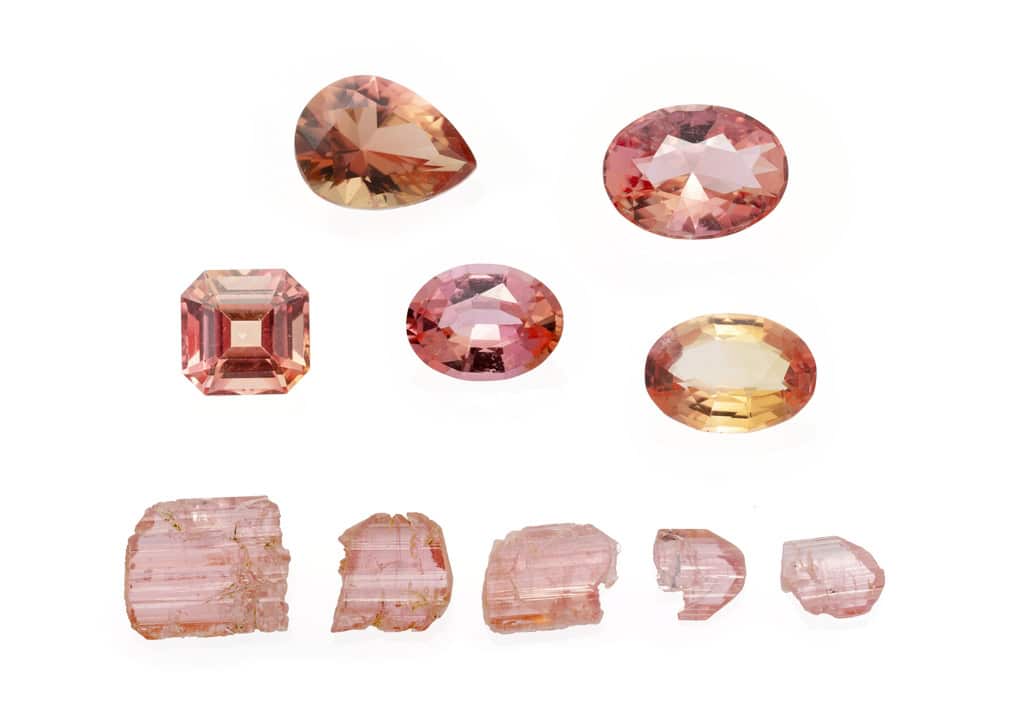
In early 2025, we were surprised to receive for testing two faceted väyrynenites of excellent quality and exceptional size, weighing 12.0 and 16.0 ct (Figure 1). The 16.0 ct gem was submitted together with a crystal (about 28 mm long and weighing 2.2 g; again, see Figure 1) during the 2025 Tucson gem and mineral shows. This new material reportedly originates from Nigeria, specifically from a pegmatite known for producing fine tourmaline, near the town of Keffi in Nasarawa State, central Nigeria (see, e.g., Akoh & Ogunleye 2014; Olobaniyi et al. 2019). Tao (2025) recently described two large faceted väyrynenites (5.00 and 5.07 ct) from an unspecified locality, and based on their similar appearance to the samples documented by the present authors, including their excellent clarity and exceptional size, we believe that they could also originate from Nigeria. The sudden appearance of faceted väyrynenite of such size and quality is exciting news to the trade and to gem collectors, and it motivated us to collect and characterise additional samples, and to compare them with specimens from the ‘classic’ locality for gem-quality väyrynenite in northern Pakistan (Figure 2).

Research study

Figure 2: In addition to the samples in Figure 1, we analysed these five faceted väyrynenites reportedly from Nigeria (0.41–1.00 ct) and five crystal fragments from Pakistan (1.03 g total). Composite photo: SSEF.

For this study, we analysed a total of 13 stones: eight samples (seven faceted and one rough) reportedly from Nigeria and five crystal fragments from northern Pakistan. A 12.0 ct faceted stone was submitted by a different client with no origin information, but we believe it is also from Nigeria based on its similarity to the other Nigerian samples.

A combination of standard gemmological techniques and advanced analytical methods was employed in this study, including refractometry, hydrostatic weighing, polariscope and dichroscope examination, UV fluorescence, gemmological microscopy, polarised UV–Vis–NIR absorption spectroscopy, Raman spectroscopy, energy-dispersive X-ray fluorescence (EDXRF), and laser ablation ICP time-of-flight mass spectrometry (LA-ICP-TOF-MS).

Visual appearance and inclusions

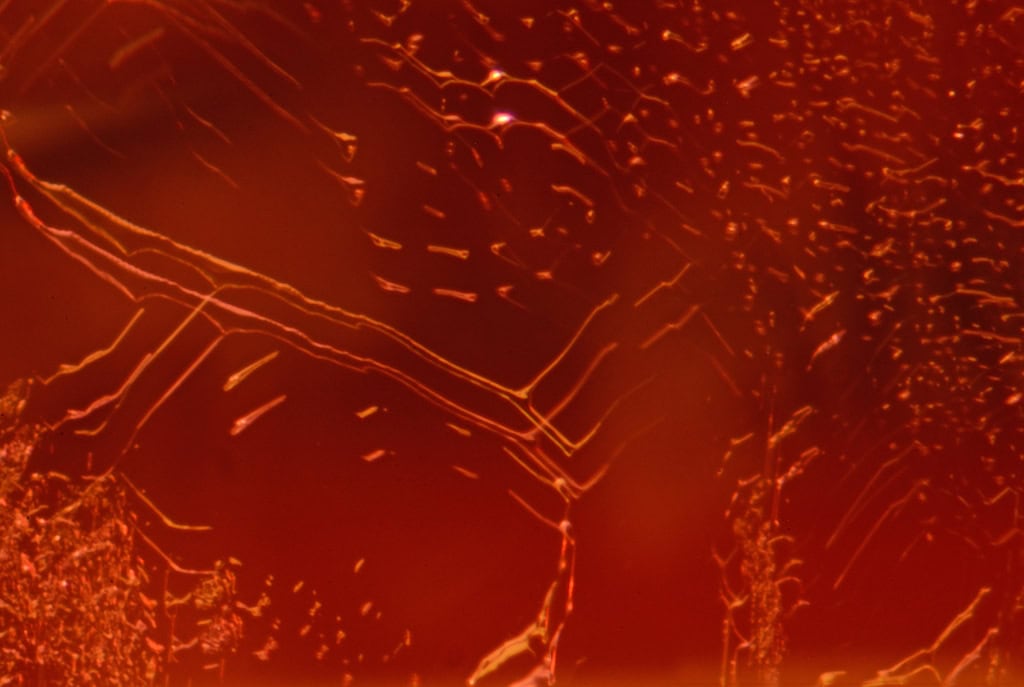
Figure 3: A partially healed fissure composed of thready fluid inclusions is seen in this väyrynenite reportedly from Nigeria. The doubling effect is a result of the distinct birefringence of this mineral. Photomicrograph by M. S. Krzemnicki; magnified 50×.

The samples from Nigeria were characterised by saturated orangey pink to orange colours. The sizes of those samples indicate the occurrence of rather large and thick crystals. By contrast, väyrynenite from Himalayan sources has typically been found as relatively small and flat crystal fragments. The Nigerian samples investigated for this study were mostly of excellent clarity, with only a few partially healed fissures occurring as partly irregular, thready, fluid-filled tubes resembling so-called trichites in tourmaline (Figure 3). By contrast, the samples we examined from Pakistan contained numerous partially healed fissures (‘fingerprints’) and hollow channels parallel to the c-axis, as described previously (Laurs & Fritz 2006a, b; Zwaan 2016).

Gemmological properties and spectroscopic analyses

Figure 4: Distinct pleochroism typical of väyrynenite is visible in the 12.0 ct sample upon rotation of the stone in plane-polarised light. Composite photo: SSEF.

The gemmological properties of the Nigerian samples were consistent with previously reported data for väyrynenite. The RI and SG values of the Pakistani material we tested (and from the literature) overlapped with the data obtained from the Nigerian samples in this study. All investigated specimens (Nigeria and Pakistan) remained inert when exposed to long- and short-wave UV radiation. Distinct trichroism was seen as pink, pinkish orange and yellowish orange pleochroic colours, especially for the larger Nigerian stones (e.g. Figure 4). Raman spectra taken in two perpendicular orientations (E||c and E┴c) showed distinct anisotropy of the vibrational peaks. This anisotropy effect was also evident in the intensity of the peak at 3214 cm–1 (related to OH; Frost et al. 2014), which was much stronger in the spectrum obtained with the laser polarisation parallel to the c-axis than perpendicular to it.

Chemical analyses

In addition to their main constituents (Mn, P and Be), all the väyrynenite samples contained significant amounts of Fe and various trace elements. The samples from Nigeria showed distinct chemical differences from our Pakistani material. Notably, the Nigerian specimens contained significantly more Fe (4.26–5.58 wt.% FeO) compared to our Pakistani samples (2.21–2.89 wt.% FeO). Also of note was a distinct difference in Zn content in our samples from the two localities. Those from Nigeria had 23.16–66.47 ppm Zn, while in our Pakistani material Zn ranged from below the detection limit to only 0.62 ppm. A plot of Fe vs Zn contents shows a clear separation for the two localities. Our väyrynenite samples from Nigeria and Pakistan can also be distinguished by their Sc, Y and REE contents. It is thus possible to separate our studied specimens originating from either source. As gemmologists and mineralogists, it is fascinating to be able to study such new material that we don’t encounter frequently in the lab.

For more detailed findings please refer to the 2025 publication in the Journal of Gemmology: Krzemnicki, M.S., Cartier, L.E., Wälle, M., 2025. Väyrynenite of Exceptional Quality and Size, Reportedly from Nigeria. Journal of Gemmology, 39(6), 569-575.