Gemmological characterisation of emeralds from Musakashi, Zambia

By Dr. Laurent E. Cartier & Dr. Michael S. Krzemnicki, first published in Facette 30 (March 2026)

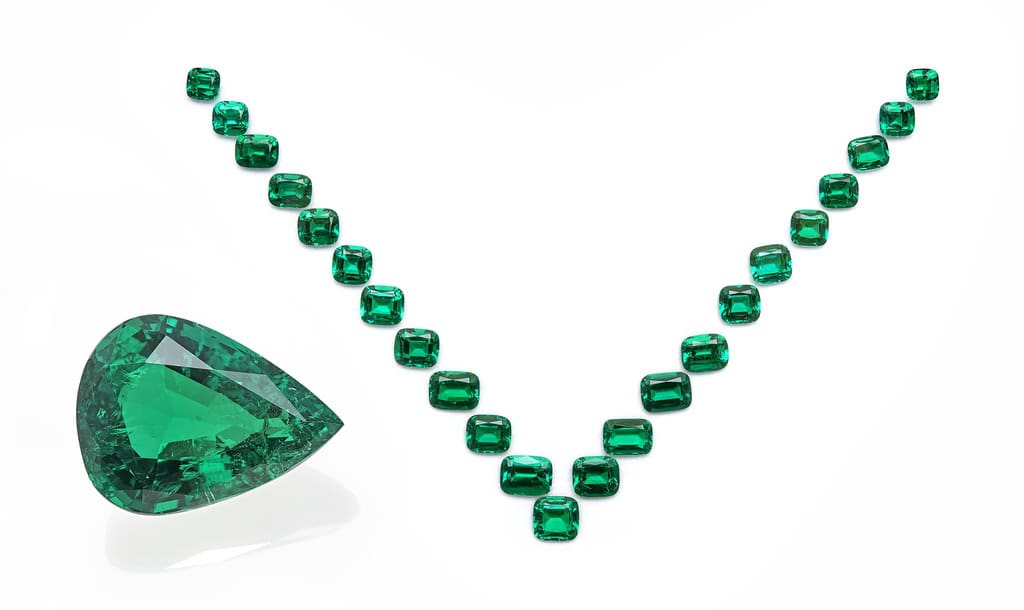
Figure 1: Gem-quality emeralds investigated for this study from the Musakashi area of Zambia (here, 2.41–4.23 ct) resemble fine-quality emeralds from Colombia. Composite photo by L. Phan, SSEF.

Zambian emeralds have been known for decades, primarily from mines along the Kafubu River in north-central Zambia (approximately 35 km south of Kitwe). Emeralds from the Kafubu area have a schist-type origin and account for the largest proportion of Zambian emeralds in the gem trade. They are characterised by high iron (Fe) concentrations and inclusions such as mica, amphibole and feldspar. In early 2002, emeralds from a different Zambian source were found in Musakashi, Solwezi District (Zwaan et al., 2005), around 160 km west of Kitwe. However, this deposit had yielded only limited quantities, with an estimated 15–20 kg of emeralds reported between its discovery and late 2010 (Klemm, 2010; Pardieu et al., 2015).

Figure 2: Examples of emeralds from Musakashi examined in the past few years at SSEF include a 21.22 ct pear shape (left) and a suite of cushion cuts ranging from 0.36 to 0.82 ct (total weight 14.6 carats). Composite photo by M. S. Krzemnicki, SSEF.

Faceted stones from Musakashi are mostly available in smaller sizes (1–5 carats), but occasionally reach 20 carats or more. They can be of very fine gem quality, exhibiting similarities to Colombian emeralds in terms of appearance, gemmological properties, inclusion features and chemical composition. Musakashi emeralds differ greatly in formation and occurrence from classic schist-hosted Kafubu material. According to Manyepa and Mutambo (2024), Musakashi emeralds are found ‘in random pockets’ in weathered chromium-enriched metasediments, which are intersected by hydrothermal veins (the source of the beryllium necessary for emerald crystallisation). Visually and chemically, Musakashi emeralds are very similar to those from Colombia and the Panjshir Valley in Afghanistan, making it challenging to determine their geographic origin (Zwaan et al., 2005; Saeseaw et al., 2014).

Previous Musakashi emerald data and erratum

From late 2017 onwards, faceted emeralds from Musakashi in Zambia were submitted to the Swiss Gemmological Institute (SSEF) for testing, with no mention of their origin. Many of these stones were of exceptional quality, albeit rather small (mostly 1–5 carats), and were submitted either as individual stones or in sets and parcels. Several research samples, reportedly from the Panjshir Valley, were donated to the SSEF a few years ago from what were, at the time, considered to be reliable sources. However, they were later found to be from Musakashi. Consequently, Krzemnicki et al. (2021a) incorrectly described these samples as originating from recent production in Afghanistan. However, we would like to clarify that the data and inclusion features attributed to the so-called ‘new emeralds’ from Afghanistan (referred to in the 2021 article as ‘Panjshir type II’) actually belong to those from Musakashi. This updated article (2024 in Journal of Gemmology) and study aims to share a detailed, consolidated set of gemmological and chemical data on emeralds from Musakashi, focusing on how to distinguish them from emeralds from Colombia and Afghanistan, as well as from other emeralds from Kafubu in Zambia.

Samples studied

For this study, we assembled a group of emeralds from four locations: Musakashi (78 samples, of which 36 were characterised by Krzemnicki et al., 2021a), Kafubu (105 samples), Colombia (92 samples, mainly from Muzo, as well as from Coscuez and Chivor), and the Panjshir Valley in Afghanistan (33 samples, of which 11 were characterised by Krzemnicki et al., 2021).
Standard gemmological testing was carried out, including measurements of refractive index, specific gravity, UV fluorescence and a microscopic examination of internal features. Additional analyses included UV–Vis– NIR spectroscopy, FTIR spectroscopy, Raman spectroscopy and chemical composition analysis using EDXRF and LA-ICP-TOF-MS (GemTOF).
The GemTOF data were analysed using t-distributed stochastic neighbour embedding (t-SNE), a machine learning algorithm that transforms high- dimensional data sets (such as multi-element concentrations from mass spectrometry) into a low-dimensional space.

Figure 3: Noticeable hollow channels oriented parallel to the c-axis are one of the most common and distinctive internal features in the Musakashi emeralds. Photomicrographs by M. S. Krzemnicki, SSEF; magnified 10× (left) and 50× (right).

Internal features and spectroscopy

The data reveal similarities in the physical properties (e.g. RI and SG) of Musakashi and Colombian emeralds, whereas the Fe-enriched schist- type emeralds from Kafubu can be easily distinguished by their higher RI and SG values. The most common and striking internal feature of Musakashi emeralds was bundles of hollow channels oriented parallel to the c-axis (see Figure 3). These cavities and channels were partly filled with orange iron hydroxide. Fluid inclusions in the Musakashi emeralds occurred as spiky to irregular multiphase inclusions. Notably, some of the multiphase fluid inclusions in our Musakashi samples exhibited a distinct ‘sawtooth’ outline, which, in our view, is highly indicative of emeralds originating from this area. By contrast, the emerald samples from Kafubu exhibited very different inclusion features. Musakashi emeralds commonly exhibited a weak Fe2+-related band in the near-infrared region (around 840 nm). The Fe-rich schist-type emeralds from Kafubu could easily be distinguished from the Musakashi and Colombian stones due to their distinct and strong Fe2-related absorption band in the near infrared. The Raman spectra of the Musakashi and Colombian emeralds were similar, showing a dominant type I H2O band at 3608 cm−1. In contrast, the Kafubu emeralds revealed a dominant Raman band at 3598 cm–1 (type II H2O).

Chemical Analyses and Geographic Origin Determination

Figure 4: By plotting Fe vs V/Cr, emeralds from Musakashi and Colombia can be separated into two distinct populations.
Figure 5: A three-dimensional t-SNE scatter plot shows well-defined clustering of emeralds based on their origin. The Zambian emeralds from Musakashi and Kafubu form distinct clusters, which are clearly separated from the clusters representing emeralds from Colombia and Panjshir. The axes in this t-SNE plot do not correspond to specific sets of elements but rather provide a visual representation of the similarity patterns among the 56 elements analysed in this study.

Our analyses revealed distinct chemical differences between the Musakashi and Kafubu emeralds, consistent with their very different geological settings. The chemical data for Musakashi and Colombian emeralds were very similar, as were their visual, gemmological and inclusion features. A bivariate plot of our data for Rb vs Cs reveals that emeralds from Kafubu and Panjshir are distinct from Musakashi and Colombian emeralds, whereas the data clusters of the latter two overlap considerably. By plotting Fe vs V/Cr, emeralds from Musakashi and Colombia are separated. The t-SNE plot (based on 56 analysed elements) shows how effectively this machine-learning approach can separate Zambian emeralds (i.e. Musakashi and Kafubu) from Colombian and Afghan emeralds.


Further reading:

Krzemnicki, M.S., Wang, H.A., Wälle, M., Lefèvre, P. and Cartier, L.E., 2024. Gemmological Characterisation of Emeralds from Musakashi, Zambia, and Implications for Their Geographic Origin Determination. Journal of Gemmology, 39(4).