Unheated pink sapphire from Madagascar with FTIR bands at 3232 and 3185 cm–1

By Michael S. Krzemnicki & Dr. Hao Wang, first published in Facette 30 (March 2026)
FTIR spectroscopy has long been used to detect heat treatment of corundum via the presence of specific absorption bands related to structurally bonded hydroxyl groups (OH) in corundum. The presence of 3232 and 3185 cm–1 peaks has been widely interpreted in gemmological literature as a robust indicator of heat treatment in metamorphic corundum.
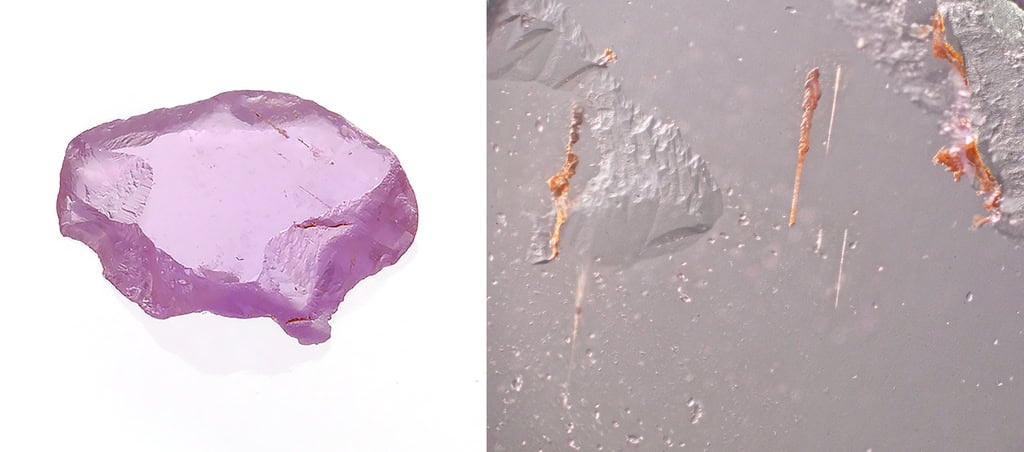
Figure 1: Unheated pink sapphire from Ilakaka (Madagascar) with goethite in deep hollow channels. Photos: H.A.O. Wang and M.S. Krzemnicki, SSEF.
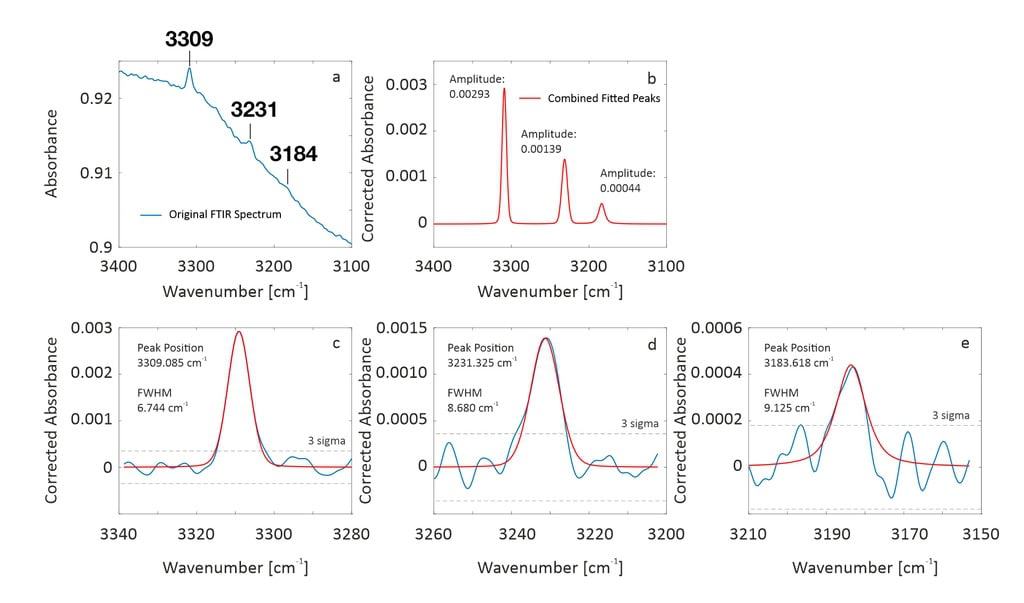
Recently, we analysed a pink sapphire from a parcel of untreated rough material that was mined in the region of Ilakaka (kindly donated by A. Leuenberger (ALine GmbH, Switzerland) and Nirina Rakotosaona (Madagascar)). Microscopic observation of one of these samples revealed the presence of numerous tiny zircon inclusions together with several hollow channels filled with a orangey brown epigenetic material, with no evident features indicating heat treatment (Figure 1). Careful spectroscopic investigation of this sample revealed a paradox. Its FTIR spectrum exhibited peaks at 3231 and 3184 cm–1 (Figure 2), as would be expected in a stone subjected to heat treatment. However, Raman analyses of the deep channel-structures confirmed that they were filled with goethite, a Fe-hydroxide which dehydrates to hematite (Fe-oxide) at temperatures between 300°C and 325°C, a range far below conventional and ‘low-temperature’ heat treatments of corundum. Therefore, the identification of goethite inclusions in this pink sapphire provided proof that the stone had not been heated.
Figure 2: FTIR spectrum of the described unheated pink sapphire. Figure: H.A.O. Wang, SSEF.

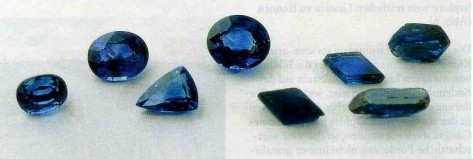
This result is consistent with data from additional samples (pink to purple and blue sapphires, as well as rubies) analysed by SSEF in recent months in which both the 3232 and 3185 cm–1 peaks were detected together with the presence of metamict zircon inclusions and/or hydroxides such as goethite and diaspore (Al-hydroxide, dehydrates at about 550°C), clearly indicating that the stones had not been heated (see also article about blue sapphires with ‘exotic’ elements on page 34 in this Facette).

Based on these findings, it is apparent that the 3232 and 3185 cm–1 FTIR peaks are not always the result of heat treatment but may also be present in unheated corundum of metamorphic origin. Consequently, their presence is not always a criterion for heat treatment. It is clear from this study that careful Raman analyses of inclusions found within a gemstone (such as goethite, diaspore and zircon) is mandatory to conclude whether or not a ruby or sapphire (of any colour) has been heat treated.