A hot issue then and now: the history and future of synthetic coloured stones
By Dr. Laurent E. Cartier & Dr. Michael S. Krzemnicki, first published in Facette 30 (March 2026)
Nature is the artist, man is only the imitator.
Ernst Haeckel (1834-1919)
The human desire to replicate and create ‘perfect’ gemstones stems from a long history of curiosity about how these beautiful materials form. Ancient theories of gem formation were often speculative: Theophrastus (ca. 315 B.C.) believed for example, that “(precious) stones are produced by solidification from fluids, some through the action of heat others of cold” (Caley, 1956).
The history of synthesising stones in some ways mirrored the ancient quest of alchemists to transmute base materials into gold. The drive to understand and recreate gems became a more formal scientific pursuit in the 19th century and ultimately led to the emergence of gemmology as a discipline as there was an urgent need to separate natural gemstones from their synthetic counterparts in the late 19th century and early 20th century.
In 1904, Joseph Chaumet of the jewellery house Chaumet addressed the Chambre Syndicale, having conducted his own research to distinguish between natural and synthetic rubies. He optimistically stated that: “I am convinced that we will always be able to recognise these two types of ruby: they will never be identical. The distinction can sometimes be difficult to establish. That is why it is necessary to use very precise methods: but I have no doubt that this distinction will always be possible.”
SSEF, founded in 1972 by Swiss trade organisations was also confronted with synthetic stones in its early days. Unlike some other labs, SSEF has only ever used the term ‘synthetic’ since it was founded, as we consider this to best describe the material. This standard did not change with the advent of synthetic diamonds in jewellery in recent years.
Although the early 20th century is often mentioned as being a peak for synthetic coloured stones as an issue in the trade, the 1970s and 1980s were also prominent. Kurt Nassau, a leading gem researcher at the time, wrote in 1979 that “The nineteen seventies were an exciting period, with many new developments in the field of synthetic gemstones. It was a difficult period for the gem expert as he struggled to keep up with a series of new synthetics, imitations, and treatments.” As gem treatments became the bigger issue in the 1980s, subsequent generations of gemmologists had less and less knowledge about synthetic coloured stones.
As today we see again an increasing volume of synthetic coloured stones appear on the market (largely due to the trend that has been set by synthetic diamonds) it seems timely to revisit this topic and provide readers with an overview of synthetic stones and some of the challenges that can exist in identifying them.
A short history of synthetic stones
One of the earliest successful attempts was the flame fusion synthesis of ruby, achieved by the French chemist Auguste Verneuil. He announced in 1902 that he had succeeded in synthesising rubies, and he published his work in 1904. Flame fusion rubies were very likely in circulation some years before 1902 and this was probably linked to previous work by Frémy and others in Paris. In 1885, Geneva rubies appeared in the market and created some confusion about their artificial or synthetic origin. By 1907, several manufacturers were producing 5 million carats of synthetic ruby per year (Nassau, 1980).
Synthetic stones were long considered a niche topic among laboratory gemmologists. It was only in the mid-to-late 2010s that a true change set in with synthetic diamonds in the trade. Over the past decade, with the rapid growth of e-commerce, social media and the huge quantities of synthetic diamonds that have flooded the market the situation has greatly changed. And the use of synthetic coloured stones is now (slowly) growing in lower-priced jewellery.
At SSEF, Verneuil synthetic rubies and sapphires have been the most commonly encountered cases over the years. Tourists would travel to a foreign country and return with what they believed to be a valuable gemstone, often set in jewellery. However, following laboratory testing, they would discover that it was a Verneuil synthetic ruby or sapphire and not the ‘real deal’ they had expected. Synthetic rubies are also commonly found in historic jewellery, which can be very valuable, as can be seen in Figure 4. It is often difficult to determine whether a synthetic ruby was intentionally mounted or not; this would often have occurred when a stone had to be replaced.
Revisiting nomenclature
In 1926, the World Jewellery Confederation (CIBJO) was established. Today, it is the world’s leading organisation in nomenclature for the trade and SSEF staff members are active in different commissions. CIBJO is clear in its definition of terms such as artificial stones, gemstone(s), imitations and synthetic stones. We list them here (from the latest edition of the CIBJO Gemstone Blue Book) for reference:
- Artificial stones: artificial products that imitate the appearance of natural materials without having their chemical composition or their physical properties or their structure.
- Gemstones: natural inorganic, organic and biogenic materials which have been formed completely by nature without human interference. Gemstones are usually used in jewellery or objets d’art due to a combination of properties that provide them with beauty, rarity and relative durability.
- Imitations: artificial products that imitate the appearance of natural materials without having their chemical composition or their physical properties or their structure.
- Synthetic stones: artificial products having essentially the same chemical composition, physical properties and structure as that of their naturally occurring counterparts.
An excellent example to illustrate the need for clear disclosure and terminology are the two ‘synthetic Paraibas’ seen in Figure 5. We purchased these as ‘synthetic Paraibas’ for research and teaching purposes at the Hong Kong show in September 2025. Seeing as tourmaline cannot be synthetised in good quality and colour, this is an obvious misnomer. Lab testing finally revealed that they are in fact Ytterbium doped yttrium aluminium garnet (Yb:YAG) crystals.
Overview of main synthesis methods for coloured stones
The creation of synthetic stones relies on more or less complex crystal growth technologies. Here we list for review the most common processes used. See also table 1 which collates information from Nassau (1980 & 1997) about when certain stones were first synthesised (in reasonable volume and quality).
1. Flame fusion (Verneuil process)
The Flame fusion method, pioneered by Auguste Verneuil, was responsible for the first commercially successful synthetic stones. This is a drop melting method where powdered material, such as aluminium oxide powder (for corundum), is dropped through a very hot oxyhydrogen flame. The powder melts at approximately 2050°C and the molten droplets fall onto a seed plate, where they slowly solidify to form a single crystal known as a ‘boule’.
Products: Corundum (ruby, sapphire, and star stones), spinel, and rutile. All colours can be achieved by adding specific chromophore trace elements.
2. Melt diffusion (flux method)
The flux method tries to mimic the slow geological crystallisation of natural stones from a molten solution. Solid basic materials are dissolved in a flux melting agent (a chemical solvent), such as PbF (tungsten), or Li2MoO4) inside a crucible (often made of platinum or iridium). The homogeneous melt is heated and then allowed to cool extremely slowly. Crystallization begins either spontaneously or on a seed crystal when oversaturation is reached.
- Products: This method is used to produce high-quality synthetics, including ruby, emerald, spinel, corundum, chrysoberyl, and beryl.
3. Hydrothermal process
This method simulates the high-pressure, high-temperature conditions under which many natural gems form in the presence of water. The process takes place in a closed steel vessel called an autoclave. Solid raw material (‘nutrient’) and seed crystals are heated in a watery solvent. High pressure and moderate temperature (400°C to 600°C) dissolve the nutrient, which then precipitates and accumulates on the seed plates due to a thermal gradient.
- Products: This method is very successful for synthesising quartz, amethyst, and beryls (including emerald, aquamarine, and red beryl).
4. High Pressure/High Temperature (HPHT) and Chemical Vapour Deposition (CVD)
These methods are primarily associated with the synthesis of diamond.
- HPHT: Used to create synthetic diamonds. It involves a capsule containing a seed crystal, diamond powder (feed), and a solvent-catalyst subjected to extreme pressure and temperature.
- CVD: Used for diamond synthesis, involving the deposition of carbon from the gas phase onto seed crystals using a plasma cloud generated by microwaves.
Modern detection challenges: 3 examples from the lab
It is a well-known fact that the likelihood of being offered a synthetic stone increases the closer you get to a mining site. Such stones are often carefully shaped or battered to resemble rough gemstones that have just been taken out of the ground.
We recently came across a case like this. An attractive, rough ‘ruby’ pebble, reportedly originating from East Africa, was submitted for testing, with the client intending to cut the stone into a faceted ruby afterwards. However, our testing quickly revealed that this stone was actually a Verneuil synthetic ruby, carefully crafted to mimic the appearance of a natural ruby pebble.
Apart from its characteristic chemical composition (pure chromium- bearing aluminium oxide, with no gallium, vanadium or iron), the most notable feature of this Verneuil-synthesised ruby was the presence of numerous gas bubbles in slightly curved zones (Figure 7). As expected, our client was less intrigued than we were by this neatly crafted synthetic ruby pebble.
Synthetic alexandrite
Alexandrite, a chromium-bearing, colour-changing variety of chrysoberyl, is a highly sought-after collector’s stone, so a gemstone report is essential. We were therefore not surprised to receive an alexandrite for testing that exhibited an attractive and distinctive colour change from bluish green to purple (Figure 8). Reportedly originating from Russia, the stone’s initial visual appearance and colour change appeared to corroborate this claim. However, we were taken aback when we started to examine the stone under our microscope. We observed metallic platinum flakes, some of which were triangular. Additionally, what initially appeared to be healing fissures containing tiny fluid inclusions were actually veils of greyish, solidified flux residue still present within the stone.
GemTOF trace element analysis confirmed the synthetic origin of this stone, revealing the presence of platinum, rhodium and indium (all of which originated from the crucible in which the synthetic alexandrite formed). This finding is supported by comparing the data of the described stone with our alexandrite database using machine learning, a subdivision of artificial intelligence (Figure 10).
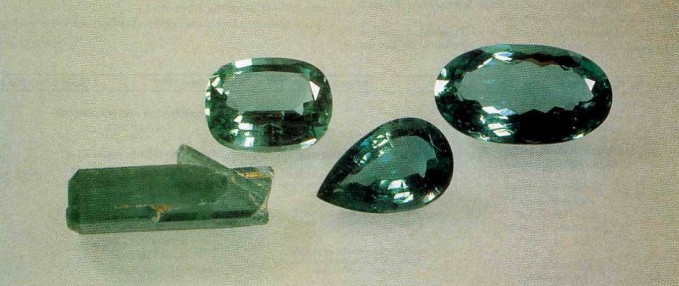
Hydrothermal synthetic emerald of 67 ct!
Although most of the faceted synthetic stones tested at SSEF are rather small, in the range of a few carats, it is possible to grow much larger crystals, including those for industrial applications (e.g. laser crystals). A less desirable situation is when such a large synthetic stone enters the gem trade without disclosure. A classic example is the 67-carat emerald submitted by an auction house for testing to confirm its authenticity.
Visually, the stone contained several aligned features resembling ‘channel structures’, as well as tiny spiky fluid inclusions, which can be expected with a Colombian emerald. However, closer inspection revealed distinct chevron structures, which are a very characteristic feature of hydrothermally synthesised emeralds (and other similarly produced stones). Additionally, the original seed plate of this synthetic stone was present, crossing the stone — unsurprising given the size of the sample investigated. The ‘channel structures’ observed were in fact identified as fractures in the seed plate, possibly developing during the growth of the synthetic emerald under high pressure and temperature in the autoclave, onto the seed plate.
The low values for its specific gravity (2.69) and refractive indices (1.69– 1.75) clearly support identification as a hydrothermally synthesised emerald. These low values reflect the fact that such synthetic emeralds are chemically pure beryl (a silicate of beryllium and aluminium) with only a small amount of chromium and vanadium as colouring elements. The chemical analysis (EDXRF) confirmed this by revealing the absence of sodium, magnesium and caesium, which are all common chemical impurities in natural emeralds (Figure 12). Additionally, the synthetic emerald contained no iron, which is unheard of in any natural emerald. However, the distinct presence of chlorine (0.77 wt% Cl) in this stone confirmed our conclusion, as chlorine has long been considered a key indicator of hydrothermal synthetic emeralds (see, for example, Hänni, 1992; Kane & Liddicoat, 1985), being a residue of the chlorine-bearing solutions (e.g. hydrochloric acid) used for their growth.
The mêlée challenge
One of the greatest challenges in the detection of synthetic coloured stones lies in the testing of mêlée, particularly when very small stones (typically 1–4 mm) are submitted in large, calibrated batches (e.g. a sample in Figure 13). At such small sizes, stones often contain no inclusions or only extremely sparse ones, removing one of the most useful indicators for rapid screening and significantly increasing the risk of undetected contamination, such as a synthetic ruby mixed into a parcel of natural rubies (as was the case in Figure 13). The problem is compounded by the economics of testing: reliable identification requires analytical protocols specifically adapted to each colour variety and frequently depends on advanced techniques such as Raman spectroscopy (for testing of inclusions) or LA-ICP-MS. These methods are time-consuming, require specialised expertise and equipment, and cannot realistically be applied at a cost of just a few pennies/dollars per stone, making comprehensive testing of mêlée both technically and financially demanding.
Conclusion
Strict and consistent adherence to correct ‘synthetic’ terminology remains essential to maintaining public trust within the coloured stone trade. While the identification of many synthetic stones can be relatively straightforward using standard gemmological methods, there are still cases that demand more advanced analytical testing as we’ve shown in the case studies above. Looking ahead, the integrity of the market will depend on continuous vigilance and close cooperation between trade organisations and leading gemmological laboratories.
Important lessons can also be drawn from the history of synthetic diamonds. Since the first successful HPHT synthesis in 1954, followed by major technological advances in both HPHT and CVD production from around 2000 onwards, the diamond market has undergone profound changes—most visibly reflected in the huge volume of synthetic diamonds now found in the trade and that have shifted consumer perceptions in some segments of the jewellery industry.
To conclude this article we’d like to share two quotes from 1886 and 1934 that still ring very much true to this day.
“Although some may be willing to have the easily attainable, there are others who will want, what the true is almost becoming today, the unattainable. The one is Nature’s gem, and the other that made by man.” George Kunz (vice president of gemmology at Tiffany & Co.) was addressing the arrival of Geneva rubies in the market in 1886.
“The synthetic serves its purpose; it does almost as well for the jewel of a fine watch as a genuine stone; it makes as good polishing material as the genuine; it is a good ornamental stone; it has its place in jewelry. But it can never supplant the naturally-occurring-the genuine stone.” Thomas Clements in Gems & Gemology (1934).